
July 19, 2026 · Michael Rodriguez

How Much Does It Cost to Run a Voice-Flag Agent Per Month?
An honest build-in-public cost breakdown for one small voice-flag agent run in the margins of a day job. Not a single magic number, line items. The model access line, the parts that are free, the overflow that varies, and how to measure your own cost per task instead of trusting somebody else's average. From an operator who sells cars for a living and builds agents with no tech background.
I sell cars for a living. Twenty years in automotive retail, no tech background, no computer science degree.
The question I get most from operators is a money question.
What does one of these agents cost to run every month?
They want a single number. One clean figure they can put in a budget line and stop thinking about.
I am not going to give them one, because the honest answer is not a number. It is a short list of line items, and most of them are zero.
This is the cost breakdown for one small voice-flag agent, run in the margins of a full day on the floor. Line items, not a magic total. And by the end you will be able to measure your own, which is the only number that was ever going to matter.
The short answer
The cost of running a voice-flag agent per month is line items, not one price. Four lines can carry cost, model access, hosting, tool APIs, and storage. At the volume one operator generates, hosting and storage sit on free tiers and tool APIs are mostly free tier, so three of the four are effectively zero. The only line that costs real money is model access, and that depends on how often the agent runs and how big a model it calls. In my own stack a $200 a month Claude Max plan is the biggest line item, and spread across 22 agents that is roughly $9 an agent for the model access line alone. That is the model line, not the total, and it is the only figure I will hand you, because your usage is not mine. The useful move is not to copy a number. It is to measure your own cost per task from a week of real runs.
Definition
Voice-flag agent:
a small agent that takes a spoken note, turns it into a structured work flag, and drops that flag somewhere you already check, so a task gets captured by talking instead of typing. Its running cost is not one figure. It is a short set of line items, and on an operator stack the only one that reliably costs money is the model call that turns the note into a record. Everything else tends to sit on free tiers.
What are the actual line items on a voice-flag agent?
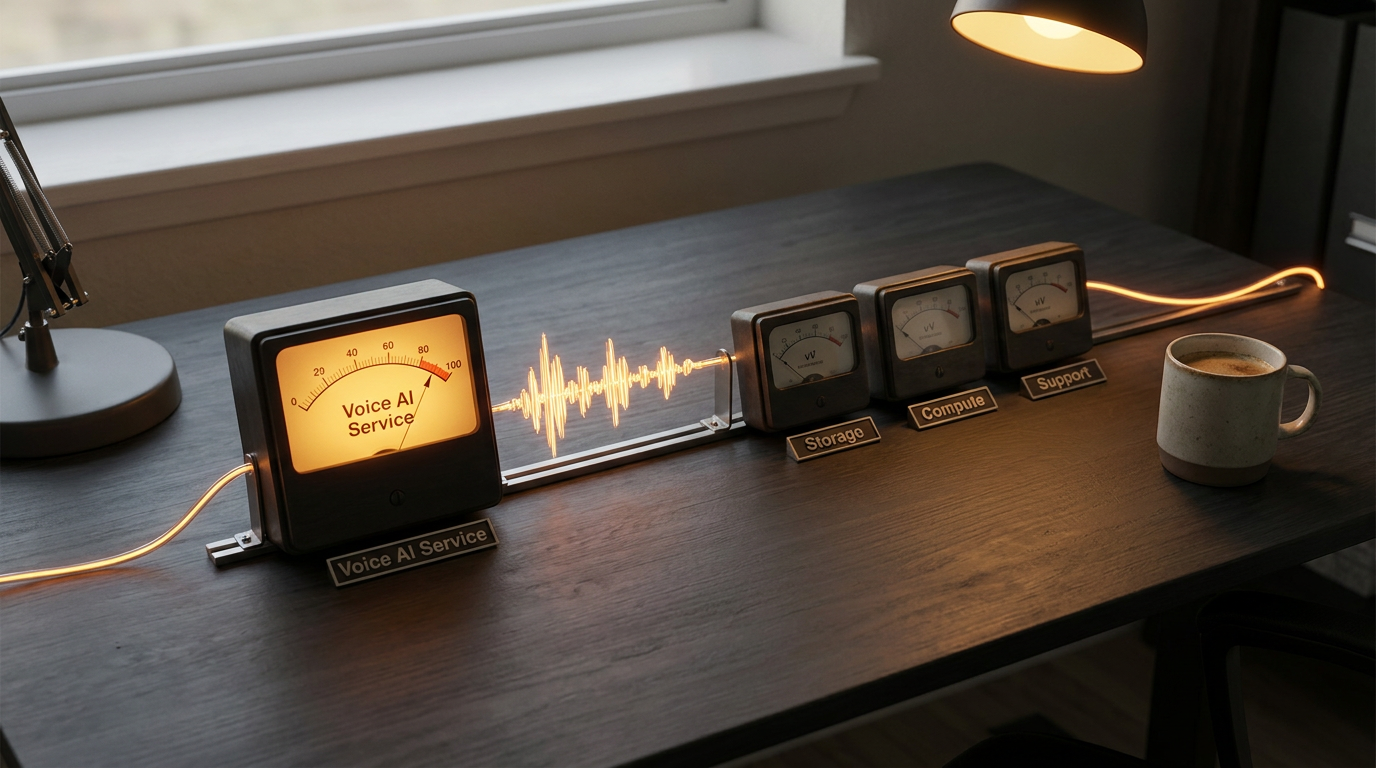
Four places money can go. Model access, hosting, tool APIs, and storage.
That is the whole map, and the map is the point. When someone asks for one number, they are flattening four lines into a total and then getting surprised that the total does not match their situation. Look at the lines instead.
Model access. This is the call that turns your spoken note into a structured flag. It is the one line that needs judgment, and the one line that reliably costs money. How much depends entirely on how often it fires and how big a model it calls.
Hosting. The compute that runs the thing. At the volume one operator generates, this sits on a free tier. One person tapping a microphone a few dozen times a day does not stress a hosting plan.
Tool APIs. The calls out to wherever the flag lands, a list or a channel. Mostly free tier at operator volume too.
Storage. Code and records. Free.
So of four lines, three are effectively zero for a single operator, and one carries the real cost. That is not me being cheap. That is the honest shape of a small agent's bill.
I built the whole 22-agent version of this line-item argument separately, if you want the fleet view of what it actually costs to run 22 AI agents. This post is the single-agent, first-build version of the same honesty.
What is the biggest line item, and why did it grow?
Model access. And I want to tell the true story of that line, because it is a build-in-public beat, not a hidden cost.
For a long time my whole stack ran under fifty dollars a month. That was real. Free tiers underneath, pay-as-you-go model calls on top, pennies per note.
Then I upgraded the model access to a $200 a month Claude Max plan on purpose. And now that plan is the biggest line item on the bill.
I am not going to quietly pretend the number never moved. The bill went up because the agents earned the raise. The model usage across the fleet crossed the point where a flat plan was cheaper than paying per call, I could name exactly which agents needed the headroom, and the flat plan became the discount instead of the splurge.
That is the difference between a cost that rises with the work and a cost that rises with a pitch deck. One is healthy. One is not.
The agents earned the raise
A cost that grows because the work grew is a good sign. The stack ran under fifty dollars a month until the model usage genuinely justified a flat plan, and then the $200 Claude Max plan became the cheaper tier, not the fancier one. Upgrade when you can name what needed the headroom. Never before.
Here is the piece that makes the per-agent math honest. That $200 model access line is not the cost of one agent. It is shared across the whole fleet. Spread across 22 agents it works out to roughly $9 an agent for the model access line. That is the model line only, not the total cost of owning an agent, and I label it that way on purpose, because calling it the full cost would be the exact kind of number that misleads people.
What parts of a voice-flag agent are actually free?
More than a vendor would ever tell you.
Hosting, free tier. Storage, free. And the part that surprises people most, the flag-closer.
When a note gets handled and the flag needs to close, that is not a job for a language model. It is a job for a script. Checking a state and flipping it is exactly the kind of dumb, reliable work a script does better and cheaper than an LLM.
On my own stack the thing that closes work flags is a 196-line bash script, and it costs zero to run. No model call, no per-token meter, no monthly plan. A script beats a language model for that job every time, and it beats it on cost by the whole amount.
The rule underneath this is simple and it is the single biggest cost lever an operator has. Anything that does not need a model to decide should not pay for one. Reserve the paid model calls for the one step that genuinely needs judgment, which on a voice-flag agent is turning a messy spoken sentence into a clean structured record. Everything else, route to a script.
I wrote the full love letter to that idea in the bash script that closes more loops than my LLMs. The short version is that the cheapest agent code is the code that never calls a model at all.
How do you measure your own cost per task?
You stop looking it up and you start measuring it.
Here is the whole method, and it takes a week.
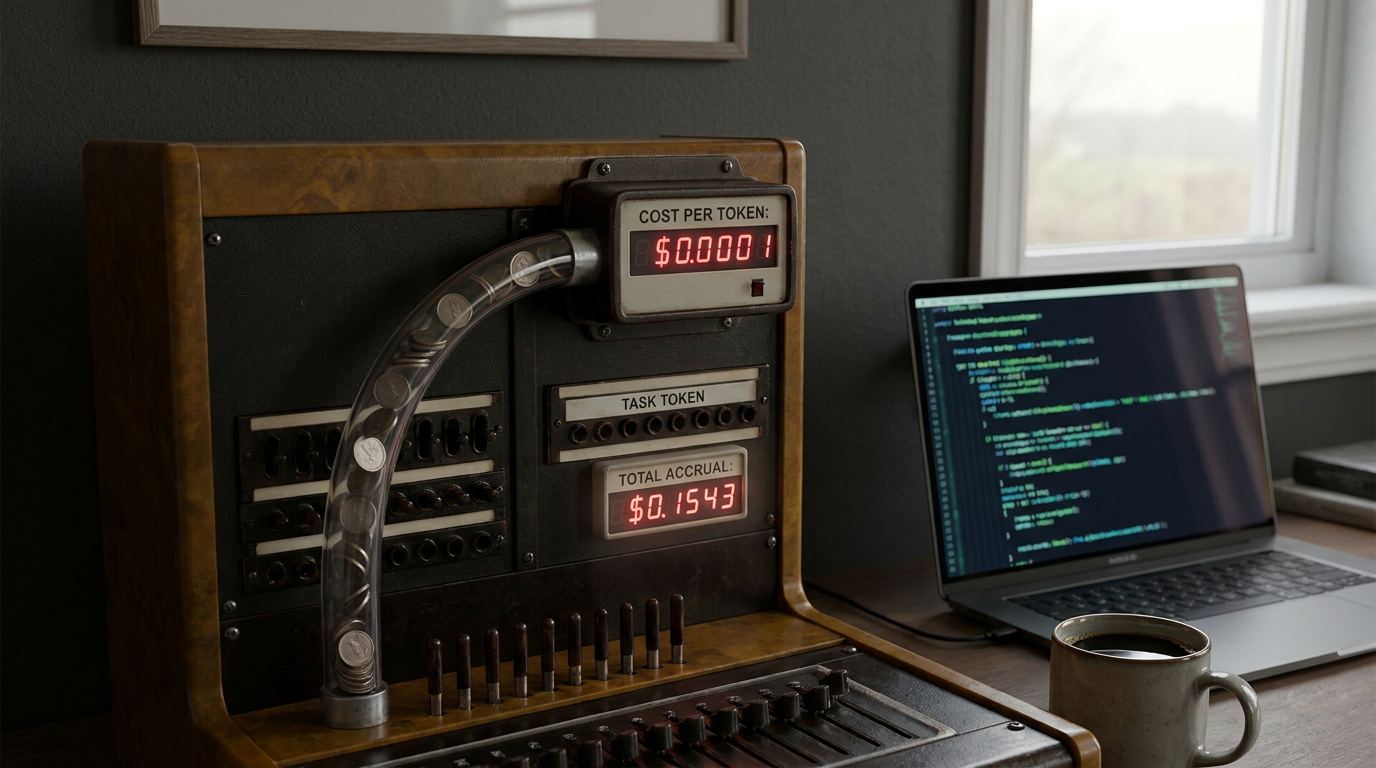
Run the agent for a week. Count the tasks it actually handled, the notes it turned into flags. Take your real model spend for that week and divide it by that count. That number is your cost per task, and it is the only cost number that was ever yours.
Do not estimate it from token math on a spec sheet. Measure it from real runs. Your notes are longer or shorter than the example you read. Your model is bigger or smaller. The only way to get your number is to watch your own agent spend real money over real work.
Once you have a real cost per task, forecasting is arithmetic. Cost per task times tasks per month is your model line. Add the free tiers underneath, which add nothing, and you have an honest monthly picture built entirely from your own usage.
The average is the thing that burns you
The operators who get surprised by a bill are the ones who budgeted against somebody else's average. A stranger's run rate and a stranger's model are not yours. Measure your own cost per task from a week of real runs. It depends stops being a dodge the moment you have your own number, and then it becomes the most useful answer there is.
For a small voice-flag agent at operator volume, that cost per task usually lands at a fraction of a cent. When the meter is that small, the smart move is to stop staring at it and go worry about whether the agent is actually useful, which is the right thing to worry about anyway.
Why is it depends actually the useful answer?
Because it depends is not a shrug. It is a map of the two things that decide your bill.
How often the agent runs. How big a model it calls.
Change either one and the number changes, even if the code is identical. A voice-flag agent that fires ten times a day is not the same bill as one that fires two hundred times a day. Same code, different cost, because cost tracks usage.
So when I tell you it depends, I am handing you the two dials, not refusing to answer. Turn down how often it runs, or turn down the model size, and the model line drops. That is control. A single fixed number would have taken that control away and replaced it with a guess.
It depends is not a dodge. It is the two dials that set your bill, how often the agent runs and how big a model it calls. A single magic number hides both. The line items hand them back to you.
This is the same reason the vendor pitch feels wrong to most operators. Typical vendor quotes for comparable services run four hundred to two thousand dollars a month, a flat enterprise figure that assumes a scale you do not have yet. The line-item view is the operator's answer to that. You pay for the one thing that costs money, you script the rest, and you measure your own number instead of buying somebody's average.
I am pre-revenue on all of this, for the record. These are not numbers dressed up to sell you a course. They are the real lines from agents I ship on evenings and lunch breaks, with the boring parts left in.
How do you keep the cost small enough to not think about?
You build the agent so the only paid step is the one that needs judgment, and you measure the rest.
- Map the four lines, model access, hosting, tool APIs, and storage, instead of chasing one total.
- Put hosting and storage on free tiers, which cover one operator's volume.
- Move any check-a-state-and-flip-it job, like closing a handled flag, into a script that costs zero.
- Reserve paid model calls for the single step that turns a spoken note into a structured record.
- Measure your real cost per task over a week of runs and forecast from your number, not a stranger's average.
Do that and the cost of a voice-flag agent stops being a scary unknown and becomes a small, known line you can name to the penny.
A voice-flag agent's monthly cost is line items, not one price. Model access is the only line that reliably costs money. Hosting, storage, and the flag-closer script are free or a fraction of that. Measure your own cost per task from a week of real runs, and it depends turns into a number you can actually trust and forecast.
The reason to think about cost this way, if you take one thing from this log, is that the number is not a fact you look up. It is a measurement you take. The operators who trust an average get surprised. The operators who measure their own cost per task never do, because they already know their two dials and where every dollar goes.
When the flag has to travel from your phone into a saved record, the honest way to wire that step is the Model Context Protocol, the open standard for how an AI reaches a tool, so the one paid model call can write to a list or a channel without you hand-wiring each destination and losing track of what you are paying for. And if you want an outside read on why the right way to pay depends on how you actually use a thing, the Harvard Business Review piece on expanding your pricing paradigm is an honest source, it lays out how metered and flat pricing each fit different usage patterns. A flat plan is a discount only after the work justifies it, which is exactly the order I upgraded in.
The community where operators ship these in public, bugs and receipts and all, is the free build log at skool.com/agent-empire-4291. Come measure your first agent's real cost per task with people doing the same. Build log, not a landing page.
While I sell cars for a living.
Michael
FAQ
How much does it cost to run a voice-flag agent per month?
There is no single honest number, because the cost is line items, not one price. For an operator running a small voice-flag agent in the margins of a day job, the meaningful lines are model access, hosting, tool APIs, and storage. Hosting and storage sit on free tiers at operator volume, so they are effectively zero. Tool APIs are mostly free tier too. The only line that costs real money is model access, and that depends on how you buy it. Pay-as-you-go is pennies per note at low volume. A flat plan spreads across every agent you run. In my own stack a $200 a month Claude Max plan is the biggest line item, and split across 22 agents that is roughly $9 an agent for the model access line alone. That is the model line, not the total cost of ownership, and it is the only number I will hand you, because your usage is not mine.
Why is the answer to agent cost always it depends?
Because the real cost tracks two things nobody can guess for you, how often the agent runs and how big a model it calls. A voice-flag agent that fires ten times a day and a version that fires two hundred times a day are not the same bill, even with identical code. It depends is not a dodge. It is the honest shape of the answer, and it is actually useful, because it tells you the number is yours to measure, not to look up. The operators who get burned are the ones who took someone else's average and budgeted against it. Measure your own cost per task and it depends turns into a number you can trust.
What parts of a voice-flag agent are free?
More than you would expect. Hosting for a small operator agent sits on a free tier at the volume one person generates. Code storage is free. The flag-closer that fires when a note is handled can be a script instead of a model call, and a script costs nothing to run. On my own stack the piece that closes work flags is a 196-line bash script, and it costs zero, because a script beats a language model for a job that is just checking a state and flipping it. The rule is simple. Anything that does not need a model to decide should not pay for one. Reserve the paid model calls for the one place that actually needs judgment, which on a voice-flag agent is turning a spoken note into a structured record.
How do you measure your own cost per task for an agent?
Run the agent for a week, count the tasks it actually handled, and divide your real model bill for that week by that count. That is your cost per task, and it is the only number that matters, because it is yours. Do not estimate from token math on a spec sheet, measure from real runs, because your notes are longer or shorter and your model is bigger or smaller than whatever example you read. Once you have a real cost per task you can forecast honestly. Cost per task times tasks per month is your model line. Everything else on a small operator agent is free tier. If the cost per task is a fraction of a cent, which for a small voice-flag agent it usually is, you stop worrying about the meter and start worrying about whether the agent is useful, which is the right thing to worry about.
Michael Rodriguez
Michael Rodriguez has spent 20 years on a dealership floor. With no tech background, he built and runs 22 production AI agents across four businesses on less than $50 a month, in evenings and lunch breaks. Agent Empire is where he ships it in public.
Building agents around a day job? Agent Empire is where operators ship it in public, together. Come build with us.