
August 21, 2026 · Michael Rodriguez

What Is an 'Agent,' Actually? A Plain-Language Field Guide
No jargon, no hype. Here is what an AI agent actually is, how it works, and why the term matters for builders in 2025.
The short answer
Definition
AI Agent: A software entity that combines a language or reasoning model with a set of tools and a loop: perceive an input, plan a response, call a tool or take an action, observe the result, and repeat until the task is complete or a stopping condition is met.
Why does the word 'agent' keep showing up everywhere right now?
The term is everywhere because the underlying capability is genuinely new. Before 2023, most AI products were one-shot: you asked, it answered, done. Agents changed that by giving the model a way to use tools, check outcomes, and keep going. Builders noticed that this unlocked tasks that a single prompt never could, such as researching a topic, drafting a document, sending an email, and logging the result, all in one unattended run.
Note
The hype followed the capability. That is why every vendor now calls everything an agent. Cutting through that noise requires understanding the actual mechanics.
What are the four parts every real agent has?
Every agent worth the name has four parts working together. Strip any one away and you have something simpler.
- A brain. Usually a large language model or a structured reasoning engine. This is the part that reads inputs and figures out what step makes sense next.
- A memory. Short-term context held in the prompt window, plus optional long-term storage in a database. Without memory, the agent forgets what it just did.
- Tools. Functions the agent can call: a web search API, a calendar write, a CRM update, a code executor. Tools are what let the agent affect the world outside the chat window.
- A loop. The code that hands the model's output back to the tool, collects the result, and feeds it back into the model. No loop, no agency.
How is an agent different from a simple workflow or a script?
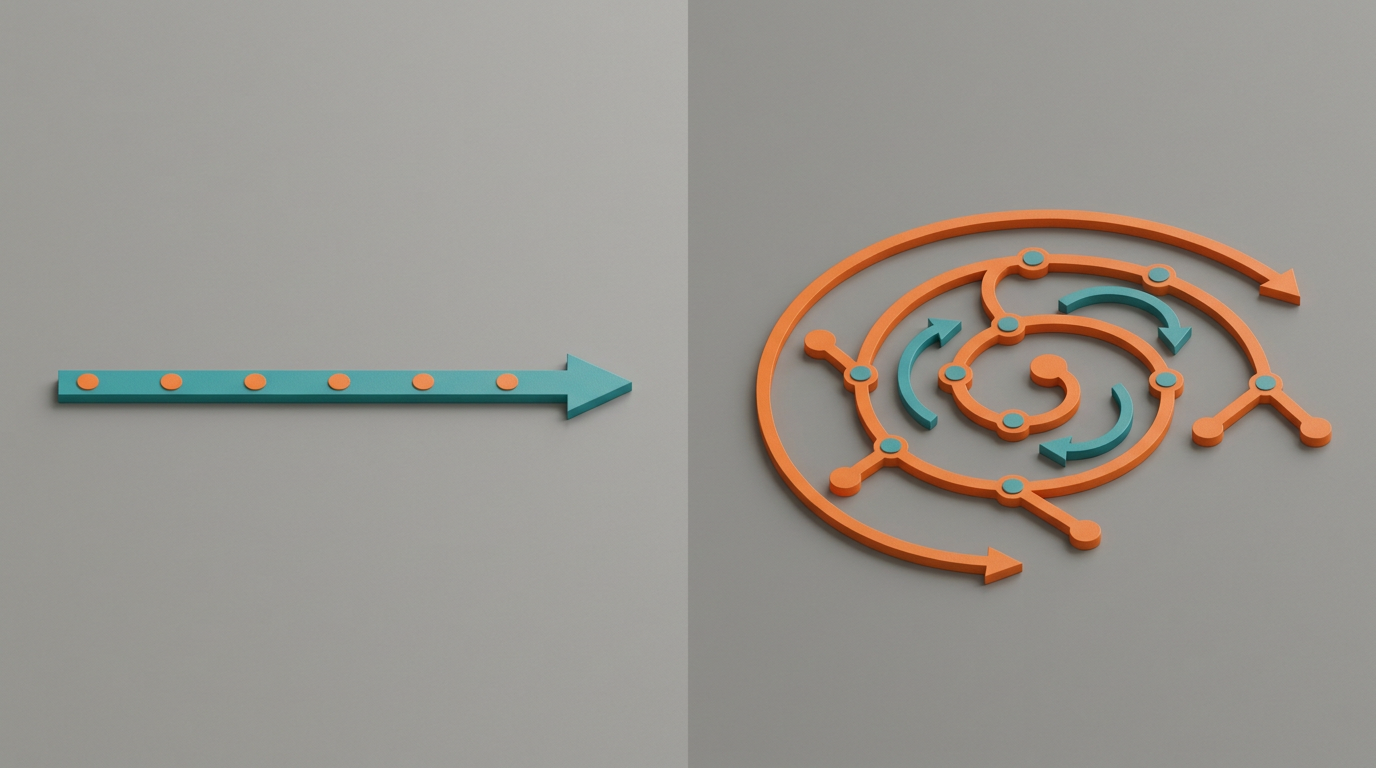
A script follows a fixed path. A workflow follows a branching path someone designed in advance. An agent chooses its own path based on what it observes at runtime. That distinction matters in practice because real tasks rarely go exactly as planned. A script that hits an unexpected API response fails. An agent can read the error, decide to try a fallback, and keep going.
A script does what you told it to do. An agent does what needs to be done to reach the goal, within the boundaries you set.
This flexibility is also the reason agents need guardrails. More autonomy means more surface area for mistakes. Good agent design is mostly about defining clear stopping conditions and keeping humans in the loop for high-stakes actions.
What kinds of tasks are agents actually good at today?
Agents are useful for tasks that have three properties: multiple sequential steps, a clear success condition, and access to the right tools. Here is a practical breakdown:
| Task type | Good fit for agents? | Why | |---|---|---| | Research and summarize a topic | Yes | Multi-step search, synthesize, write | | Answer a single factual question | No | One-shot is faster and cheaper | | Book a meeting across time zones | Yes | Read calendar, check availability, write event | | Generate a logo | No | One model call, no loop needed | | Follow up on unpaid invoices | Yes | Check CRM, draft email, log action, wait, repeat | | Translate a document | No | Single API call suffices |
The pattern: if a human would need to open several tabs and check results before moving to the next step, an agent probably fits. If a human would just type a query and read the answer, a direct model call is cleaner.
Where does an agent fit in a real business build?
Most small business agent stacks in 2025 look like this: a trigger such as a new lead form or an inbound message starts the agent, the agent gathers context using tools such as a CRM lookup or a web search, drafts and sends a response or schedules a next action, and then logs everything back to a record-of-truth database. The human reviews exceptions, not every transaction.
If you are exploring what a ten-agent business looks like end to end, the 10-agent framework maps out which agent handles which function and how they hand off between each other.
Note
For a deeper look at how individual agent types such as intake agents, follow-up agents, and delivery agents behave differently in the field, the agent build logs on the blog track real builds with ledger-level notes on what worked and what did not.
What should you read if you want to go deeper on the technical side?
The research team at Anthropic published a plain-language overview of agent architectures that is worth bookmarking: Anthropic's Claude agents documentation. Google DeepMind's paper on ReAct, the reasoning-plus-action framework that underlies most modern agents, is the foundational academic reference if you want to understand why the loop works the way it does.
Neither source requires a machine learning background to follow. Both are honest about current limitations, which is the signal that the writing is trustworthy.
Michael Rodriguez
Michael Rodriguez has spent 20 years on a dealership floor. With no tech background, he built and runs 22 production AI agents across four businesses on less than $50 a month, in evenings and lunch breaks. Agent Empire is where he ships it in public.
Building agents around a day job? Agent Empire is where operators ship it in public, together. Come build with us.