
August 12, 2026 · Michael Rodriguez

What Tools Do You Actually Need to Build Your First Agent?
A no-fluff field guide to the exact tools required to ship your first AI agent, with honest trade-offs and zero hype.
The short answer
Definition
AI Agent: An AI agent is a program that uses a language model to decide which actions to take, executes those actions through tools or APIs, observes the results, and repeats the loop until a goal is met or a stop condition triggers.
Building your first agent is mostly a tool-selection problem. The field moves fast, options multiply weekly, and most tutorials skip straight to the fancy parts without explaining what is load-bearing versus decorative. This post is a ledger of what you genuinely need, what you can skip on day one, and why.
What is the minimum viable agent stack?
Four layers cover the whole loop. You can wire them together in an afternoon.
- Language model API - the brain. OpenAI, Anthropic, Google Gemini, Mistral, or a local model via Ollama all work. Pick one you can call over HTTP today.
- Orchestration layer - the loop manager. This is the code that sends prompts, receives responses, parses tool calls, and decides whether to keep going. LangChain, LlamaIndex, and CrewAI are popular options. A plain Python while-loop also works for a first build.
- Tools or actions - the hands. A tool is any function the model can invoke: a web search, a calculator, a database query, a file write. Without at least one tool the agent is just a chatbot.
- Runtime - the place the loop runs. Your laptop, a cloud function, a simple server. For a first agent, localhost is fine.
Note
Which language model API should you start with?
Start with the one that has the most reliable function-calling or tool-use support in its documentation, because tool calling is the mechanism agents depend on most.
OpenAI's GPT-4o and Anthropic's Claude 3.5 Sonnet both have well-documented, stable tool-calling specs as of mid-2025. Google's Gemini 1.5 Pro supports function calling too. All three have free tiers or low-cost pay-as-you-go pricing that keeps first-build costs under about 5 dollars for a few hundred test runs.
If data privacy is a constraint from day one, Ollama lets you run Llama 3 or Mistral locally at zero API cost, though you lose some reliability on complex tool calls.
What orchestration framework should you use?
For a first agent, the honest answer is: as little as possible.
A raw Python script with a while-loop, a dictionary of tool functions, and direct API calls teaches you what is actually happening inside every framework. Once you understand the loop, frameworks become useful rather than magical.
If you want a framework from the start, here is a plain comparison:
| Framework | Best for | Learning curve | Lock-in risk | |---|---|---|---| | Plain Python | Understanding the loop | Low | None | | LangChain | Broad ecosystem, many integrations | Medium | Medium | | LlamaIndex | Data-heavy retrieval tasks | Medium | Low | | CrewAI | Multi-agent role patterns | Low to start | Medium | | AutoGen | Research-style multi-agent | High | Low |
Start with plain Python or CrewAI. Graduate to LangChain when you need a specific integration it already has built.
The framework is not the agent. The loop is the agent. Every framework is just someone else's loop with extra configuration.
What tools should your first agent have?
One real tool is enough to make an agent genuinely useful. Two or three tools cover most first projects.
The most practical starter tools are:
- Web search - Tavily and Serper both offer search APIs built for agent use with structured JSON returns. Tavily has a free tier documented at tavily.com.
- Code execution - a sandboxed Python interpreter lets the agent do math, parse data, and manipulate files without hallucinating answers.
- File read/write - simple local file tools let an agent persist work across steps, which is often the difference between a demo and something useful.
- HTTP requests - a generic fetch tool lets the agent hit any REST API you point it at.
Avoid building a large tool library before you know which tools the agent actually reaches for. Instrument your runs and look at tool-call frequency before adding more.
How do you wire the loop together in practice?
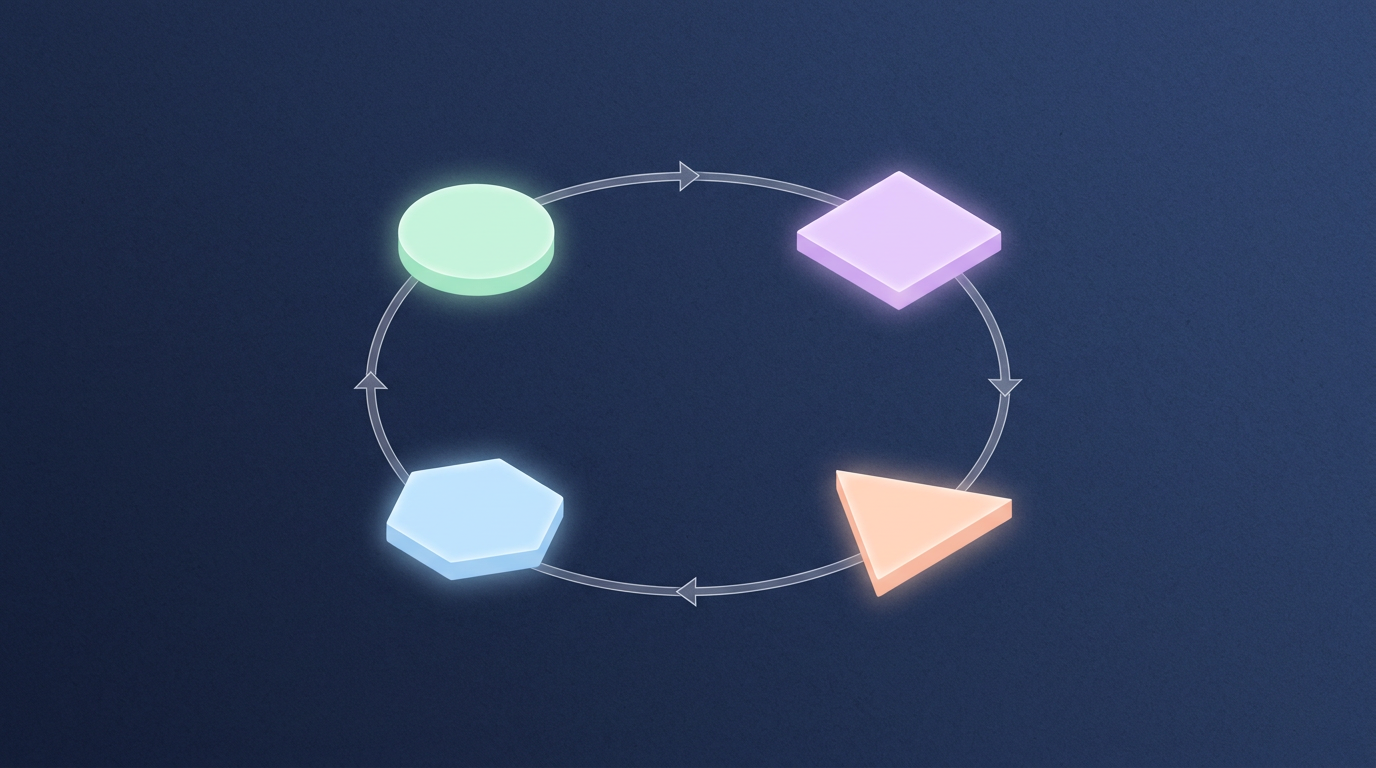
The sequence is the same regardless of which specific tools you pick.
Every framework you will encounter is an abstraction over exactly this sequence. Knowing it step by step means you can debug any framework failure because you know what should be happening at each stage.
Note
What should you skip on the first build?
Several things get heavy marketing attention but solve problems you will not face until agent version two or three.
Vector databases and RAG are for when your agent needs to search a large private document corpus. If your first agent has three tools and one task, you do not need Pinecone or Weaviate yet.
Long-term memory frameworks like Mem0 or Zep are for when your agent needs to remember facts across many separate sessions. Skip them until session continuity becomes a real user complaint.
Multi-agent orchestration like a LangGraph graph or a CrewAI crew with five roles is for tasks that genuinely benefit from parallelism or specialization. A single-agent loop handles the majority of first use cases.
Visual builders like Flowise or Rivet are helpful for non-engineers or for rapid prototyping, but they add an abstraction layer that makes debugging harder when you are trying to learn the fundamentals.
Where can you go deeper on agent architecture?
Once your first loop is running, the next questions are usually about reliability, memory, and multi-step planning. The 10 agents patterns guide covers the most common agent architectures with concrete trade-offs. For the prompting side of agent construction, the agent prompting playbook walks through system prompt structures that hold up under real task pressure.
For external reference, Anthropic's published research on building effective agents is one of the most grounded reads in the field, written by people who run these systems at scale.
Michael Rodriguez
Michael Rodriguez has spent 20 years on a dealership floor. With no tech background, he built and runs 22 production AI agents across four businesses on less than $50 a month, in evenings and lunch breaks. Agent Empire is where he ships it in public.
Building agents around a day job? Agent Empire is where operators ship it in public, together. Come build with us.