
August 17, 2026 · Michael Rodriguez

What Is the Smallest Agent Worth Building?
Find the minimum viable agent that actually earns its keep. Builder field-notes on scope, trigger design, and the one-tool rule.
The short answer
Definition
Minimum Viable Agent: A minimum viable agent is the smallest autonomous loop that has a defined trigger, access to exactly the tools required to act on that trigger, and a stopping condition, with no extra surface area bolted on during discovery.
Why does agent scope matter so much at the start?
Scope determines failure radius. A narrow agent fails quietly and fails cheap. A broad agent fails in ways that touch your data, your customers, and your downstream systems all at once. Starting small is not a lack of ambition; it is risk management.
Note

What makes a trigger worth automating?
A trigger is worth automating when it fires frequently, the response is deterministic enough to describe in a short ruleset, and the cost of a wrong answer is bounded. Run every candidate trigger through this three-part check before you build anything.
The three-part trigger check:
- Frequency: Does this happen at least a few times a week? One-off tasks do not justify the maintenance overhead of a live agent.
- Determinism: Can you write down the decision logic without needing a meeting? If the answer depends on context a human must read, it is not ready.
- Bounded failure: If the agent gets it wrong, can you recover cheaply? Sending a slightly off-tone reply is recoverable. Deleting a production record is not.
An agent is not a chatbot with memory. It is a closed loop: trigger, reasoning, action, stop. If it never stops, it is not an agent, it is a process gone wrong.
How do you pick the one tool that makes the agent real?
Map every candidate action to a single tool call. If the job requires two tool calls to complete the minimum useful outcome, treat that as a signal that you have either two separate agents or a workflow, not a single agent. The one-tool rule keeps the agent auditable. You can log every call, replay it, and know exactly what changed.
Practical one-tool examples that ship fast:
- A Slack message arrives in a support channel, the agent reads it, calls a search tool against your knowledge base, and posts a suggested reply thread for a human to approve.
- A new row lands in a CRM staging table, the agent reads it, calls an enrichment API, and writes the enriched record back.
- A form submission fires a webhook, the agent reads the payload, calls a ticket-creation endpoint, and confirms the ticket ID in a log sheet.
None of these require a model with long context. None require memory beyond the current event. All three are describable in one sentence.
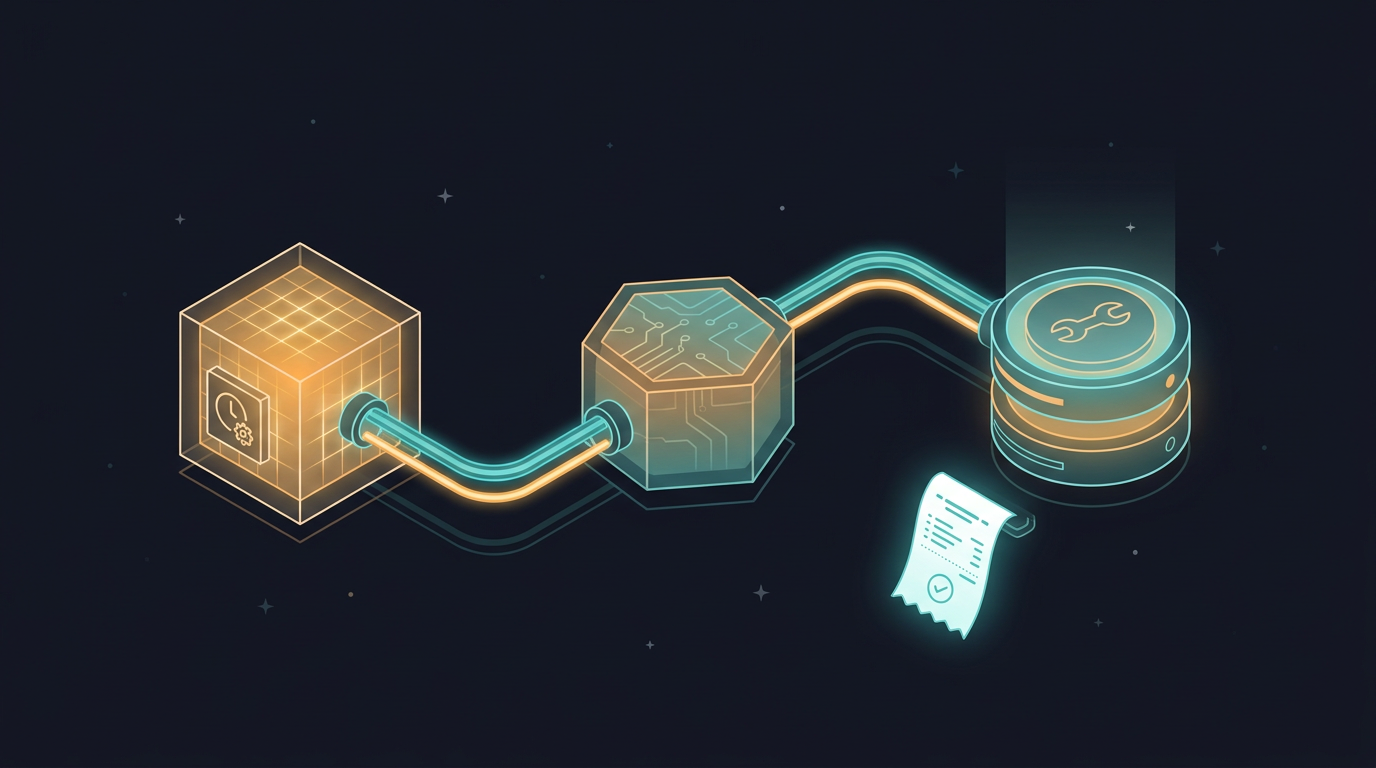
What does the build sequence actually look like?
The manual step matters. Running the tool call by hand before you automate it shows you the real response schema, the failure modes, and the latency. Builders who skip this step write prompts against an imagined API, not the real one.
How small is too small?
An agent is too small when a single line of deterministic code would do the same job with no reasoning required. Routing an integer to one of two buckets based on a threshold is a conditional, not an agent. The inflection point is ambiguity: if the input requires interpretation before the right action can be chosen, a model earns its place in the loop.
A useful heuristic: if a junior hire could follow your written logic without asking a single clarifying question, use a script. If they would need to read context and make a judgment call, consider an agent.
What scope mistakes show up most often?
Three patterns repeat across builder post-mortems:
- The assistant creep: The agent starts as a single-trigger loop and accumulates tool calls over weeks until it is doing five different jobs. Each addition felt small at the time. Version your agent definitions the same way you version code.
- The human-in-the-loop skip: The builder removes the approval step too early because the first hundred runs looked clean. Add the approval step back any time the action touches external systems or customer-facing data.
- The vague stopping condition: The agent keeps calling tools because the prompt never told it when to stop. Every agent prompt needs an explicit terminal state written in plain language.
Note
Where does the minimum viable agent fit inside a larger system?
Small agents compose. Once a single-trigger agent is stable, it can emit a structured output that becomes the trigger for a second agent. This is the pattern behind most production multi-agent systems: a chain of narrow loops, not one large reasoning engine trying to do everything.
For a closer look at how individual agents slot into larger orchestration patterns, see how 10-agent stacks get structured and how agent handoffs get designed.
The academic framing for this comes from research on agent modularity. The ReAct paper from Yao et al. at Princeton and Google Brain showed that interleaving reasoning and action in tight loops outperforms monolithic chain-of-thought on tool-use tasks, which is empirical support for keeping each loop small and focused. You can read the original at arxiv.org/abs/2210.03629.
For production rate-limit and cost data on tool-calling models, the Anthropic model documentation at docs.anthropic.com publishes current token pricing and context limits that bear directly on how many tool calls fit inside a single agent loop economically.
What should you ship in the first two weeks?
Pick one internal process that fires daily, write the trigger condition in one sentence, identify the one tool call that resolves it, and run the build sequence above. Do not add a second tool until the first has run cleanly for two weeks in a row. The discipline is the method.
More build patterns and scoping templates are indexed on the blog. If you are designing a stack rather than a single agent, the 10-agents reference architecture shows how narrow loops chain into production systems.
Michael Rodriguez
Michael Rodriguez has spent 20 years on a dealership floor. With no tech background, he built and runs 22 production AI agents across four businesses on less than $50 a month, in evenings and lunch breaks. Agent Empire is where he ships it in public.
Building agents around a day job? Agent Empire is where operators ship it in public, together. Come build with us.