
July 22, 2026 · Michael Rodriguez
How to Add a One-Tap Microphone to a Simple Web App
A field-notes guide to wiring the MediaRecorder API into a web app so users can record audio with a single tap, no plugins needed.
The short answer
Definition
MediaRecorder API: A browser-native interface, part of the MediaStream Recording specification published by W3C, that lets JavaScript capture audio or video streams from hardware devices and encode them into a downloadable or uploadable Blob without any server-side dependency.
Building a talk-to-your-app feature sounds intimidating the first time. It is not. The browser ships everything you need. This post walks through the exact steps, the gotchas, and the wiring decisions you will face on a real project.
What browser APIs are actually involved?
Two APIs do all the work. getUserMedia opens the hardware stream. MediaRecorder encodes it.
- navigator.mediaDevices.getUserMedia returns a Promise that resolves to a MediaStream. You pass a constraints object, for example
audio: true, to tell the browser you only want microphone input, not camera. - MediaRecorder wraps that stream. You call
.start()to begin encoding and.stop()to finalize. Each encoded chunk fires adataavailableevent. You collect those chunks, then callnew Blob(chunks, type: 'audio/webm')once recording ends. - URL.createObjectURL turns the Blob into a local URL you can drop straight into an
<audio>element for immediate playback.
Browser support is broad. As of 2024, MediaRecorder is available in Chrome, Edge, Firefox, and Safari 14.1 and later, per the MDN compatibility table at developer.mozilla.org.
Note
audio/mp4 as the MIME type. Chrome and Firefox accept audio/webm. Check with MediaRecorder.isTypeSupported before hardcoding a format.How do you structure the minimal HTML and JavaScript?
Start with the smallest possible surface. One button, one audio element, zero build tools.
<button id="rec">Hold to record</button>
<audio id="playback" controls></audio>
const btn = document.getElementById('rec');
const playback = document.getElementById('playback');

let recorder, chunks = [];

async function startRecording() {
  const stream = await navigator.mediaDevices.getUserMedia({ audio: true });
  recorder = new MediaRecorder(stream);
  chunks = [];
  recorder.ondataavailable = e => chunks.push(e.data);
  recorder.onstop = () => {
    const blob = new Blob(chunks, { type: recorder.mimeType });
    playback.src = URL.createObjectURL(blob);
  };
  recorder.start();
}

function stopRecording() {
  if (recorder && recorder.state !== 'inactive') recorder.stop();
}

btn.addEventListener('mousedown', startRecording);
btn.addEventListener('mouseup', stopRecording);
btn.addEventListener('touchstart', e => { e.preventDefault(); startRecording(); });
btn.addEventListener('touchend', stopRecording);
That is the complete one-tap pattern. The touch events with preventDefault stop mobile browsers from firing a delayed click after the touchstart, which would call startRecording twice.
What permissions and security constraints do you need to know?
Permissions are the most common place where this breaks in production.
getUserMedia only works on a secure context. That means HTTPS in production. On localhost, browsers grant an exception for development. The moment you deploy to a non-HTTPS URL, the call throws a NotAllowedError before your code even runs.
Key constraints to keep in mind:
- The permission prompt fires the first time getUserMedia is called, not when the page loads. Place your call inside the button handler so the user gesture is fresh. Some browsers block permission prompts that happen without a recent user interaction.
- Once a user denies permission, you cannot re-prompt programmatically. You have to tell the user to reset site permissions in browser settings.
- iOS Safari before 14.1 does not support MediaRecorder at all. If you need older iOS coverage, you need a fallback such as the Web Audio API with a ScriptProcessor, which is considerably more complex.
The permission prompt is a trust handshake. Fire it only when the user explicitly asks to record, not on page load, or they will deny it out of surprise.
How do you handle the one-tap pattern on mobile vs desktop?
Desktop and mobile have different event models, and mixing them wrong produces double-starts or missed stops.
| Device | Recommended events | Notes | |--------|-------------------|-------| | Desktop mouse | mousedown / mouseup | Simple and reliable | | Mobile touch | touchstart / touchend | Add e.preventDefault() on touchstart | | Keyboard-only | keydown / keyup on Space | Required for accessibility | | Single toggle (no hold) | click to toggle state | Simpler UX for long recordings |
For a toggle pattern instead of hold-to-record, keep a boolean flag in state and flip it on each click. That is friendlier for recordings longer than a few seconds because the user does not have to hold a button.
Note
How do you upload the recorded audio to a server?
Once you have the Blob, uploading is standard FormData.
recorder.onstop = async () => {
  const blob = new Blob(chunks, { type: recorder.mimeType });
  playback.src = URL.createObjectURL(blob);

  const form = new FormData();
  form.append('audio', blob, 'recording.webm');
  await fetch('/api/audio', { method: 'POST', body: form });
};
On the server side, treat it like any file upload. In Node.js with Express, multer handles the multipart parsing. In Python with FastAPI, use UploadFile. The Blob arrives as a binary file with the MIME type the recorder reported.
If you are feeding the audio into a speech-to-text service, most APIs accept webm/opus or mp4/aac directly. OpenAI's Whisper API accepts webm, for example, so you can POST the raw Blob without any re-encoding step.
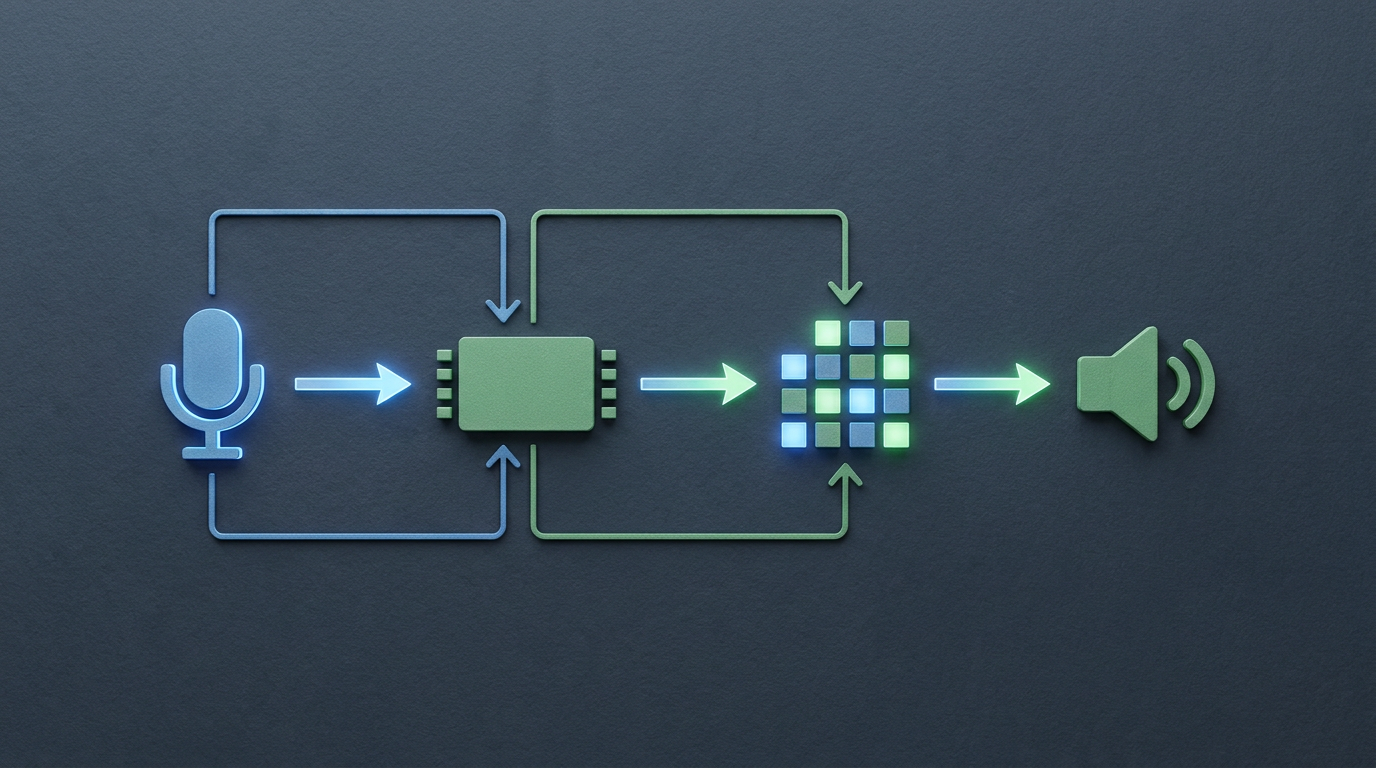
For AI-powered voice features inside multi-agent products, the recording widget is usually the thin front end of a longer pipeline. See how 10-agent workflows handle audio input routing, and browse related build guides on the blog for connecting the upload endpoint to a transcription step.
What are the most common bugs and how do you fix them?
A short field log of the issues that appear on almost every first build:
- Double permission prompt on iOS: Caused by calling getUserMedia twice. Cache the stream in a module-level variable and reuse it.
- Empty Blob on short recordings: MediaRecorder batches chunks. Call
recorder.requestData()before stop if you need a chunk for recordings under one second. - No audio on playback in Chrome: Usually the audio element needs
controlsor an explicit.play()call after settingsrc. Autoplay policies block silent starts. - CORS error on upload: Your fetch target needs CORS headers that allow the origin of your app. A missing
Access-Control-Allow-Originheader is not a MediaRecorder problem, it is a server config problem. - Mic stays open: After recording, call
stream.getTracks().forEach(t => t.stop())to release the hardware. If you skip this, the browser tab keeps showing the recording indicator indefinitely.
The W3C MediaStream Recording specification at w3.org/TR/mediastream-recording is the authoritative source for event timing and state machine behavior if you need to debug edge cases beyond what MDN covers.
A one-tap microphone is genuinely one of the faster features to ship in a web app once you know the state machine. The API is stable, the browser surface is wide enough for most audiences, and the path from recorded Blob to API upload is a handful of lines. Build the minimal version first, confirm it works on both desktop and a real iOS device, then layer in the upload and any downstream processing.
Michael Rodriguez
Michael Rodriguez has spent 20 years on a dealership floor. With no tech background, he built and runs 22 production AI agents across four businesses on less than $50 a month, in evenings and lunch breaks. Agent Empire is where he ships it in public.
Building agents around a day job? Agent Empire is where operators ship it in public, together. Come build with us.