
August 28, 2026 · Michael Rodriguez
No-Code vs Code: Which Should an Operator Pick for a First Agent?
Builder field-notes on choosing no-code or coded infrastructure for your first AI agent. Honest trade-offs, real constraints, no hype.
The short answer
Definition
AI Agent: An AI agent is a software process that accepts a goal, breaks it into steps, calls tools or APIs on its own initiative, and returns a result without a human steering each action. The agent loop runs observe, plan, act, and evaluate repeatedly until the goal is met or a stopping condition is hit.
Building your first agent is mostly a question of where you want to spend your ramp-up time. Both paths produce a running agent. The difference is which kind of friction you will carry into the project.
What does "no-code" actually mean in the agent context?
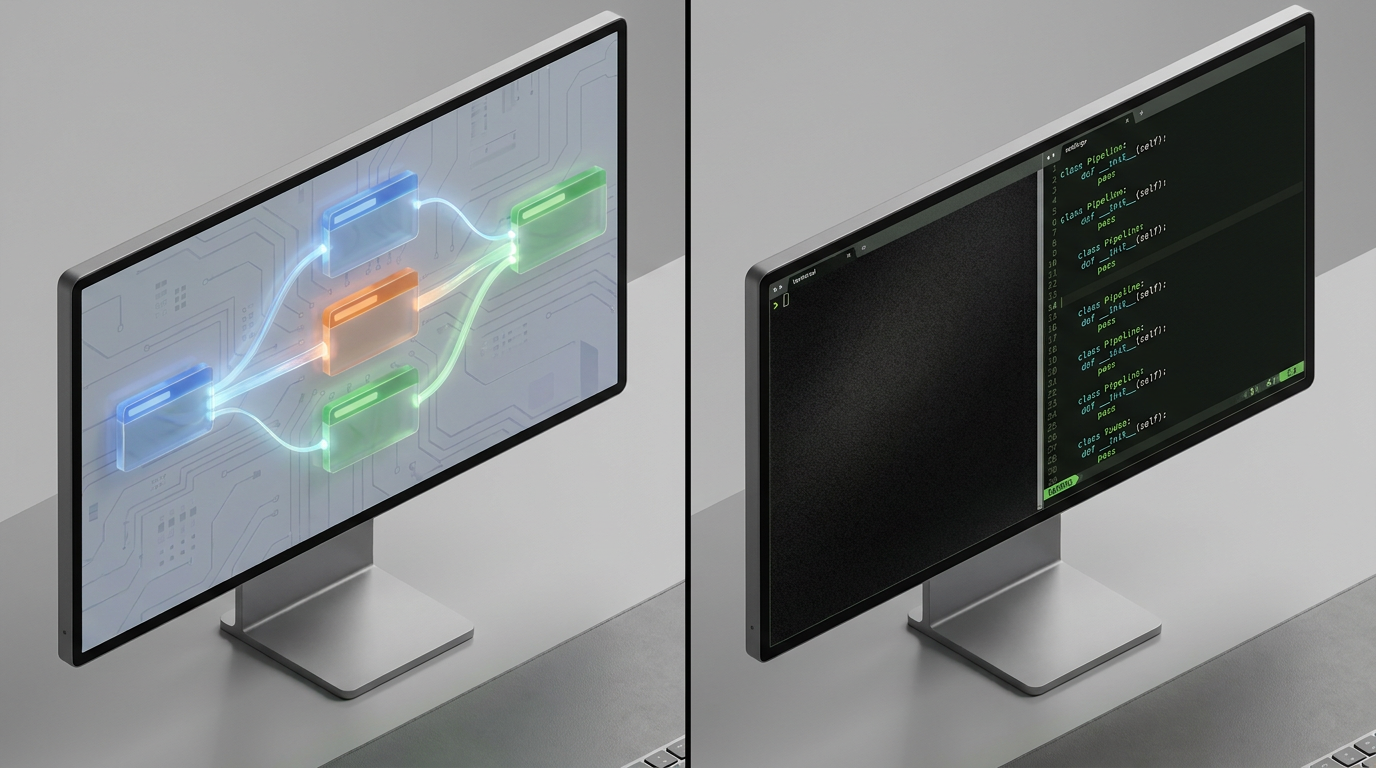
No-code agent builders let you assemble logic from a canvas of pre-built nodes: triggers, LLM call blocks, memory stores, and output formatters. You connect them visually, fill in text fields, and deploy without touching a terminal. Tools in this category include platforms like Make, n8n, Voiceflow, and the growing agent-specific builders that have appeared since 2023.
Note
The capability ceiling matters here. Most visual builders handle linear or lightly branching flows well. They struggle when you need dynamic tool selection, multi-agent handoffs with shared memory, or fine-grained retry logic that changes based on a parsed error code. That ceiling is rising fast as platforms add "agentic" layers, but as of mid-2025 it remains real.
What does a coded agent actually require?
A coded agent typically means Python or TypeScript scaffolding using a framework such as LangChain, LlamaIndex, AutoGen, or a thinner wrapper around a provider SDK. You control the agent loop explicitly. You write the tool definitions, the prompt templates, the memory read and write calls, and the evaluation hooks.
The cost is setup time and ongoing maintenance. A first-time builder who has never worked with async Python or environment variable management will spend meaningful hours on infrastructure before the agent does anything useful. That is not a reason to avoid code forever. It is a reason to be honest about the budget.
How should an operator actually choose?
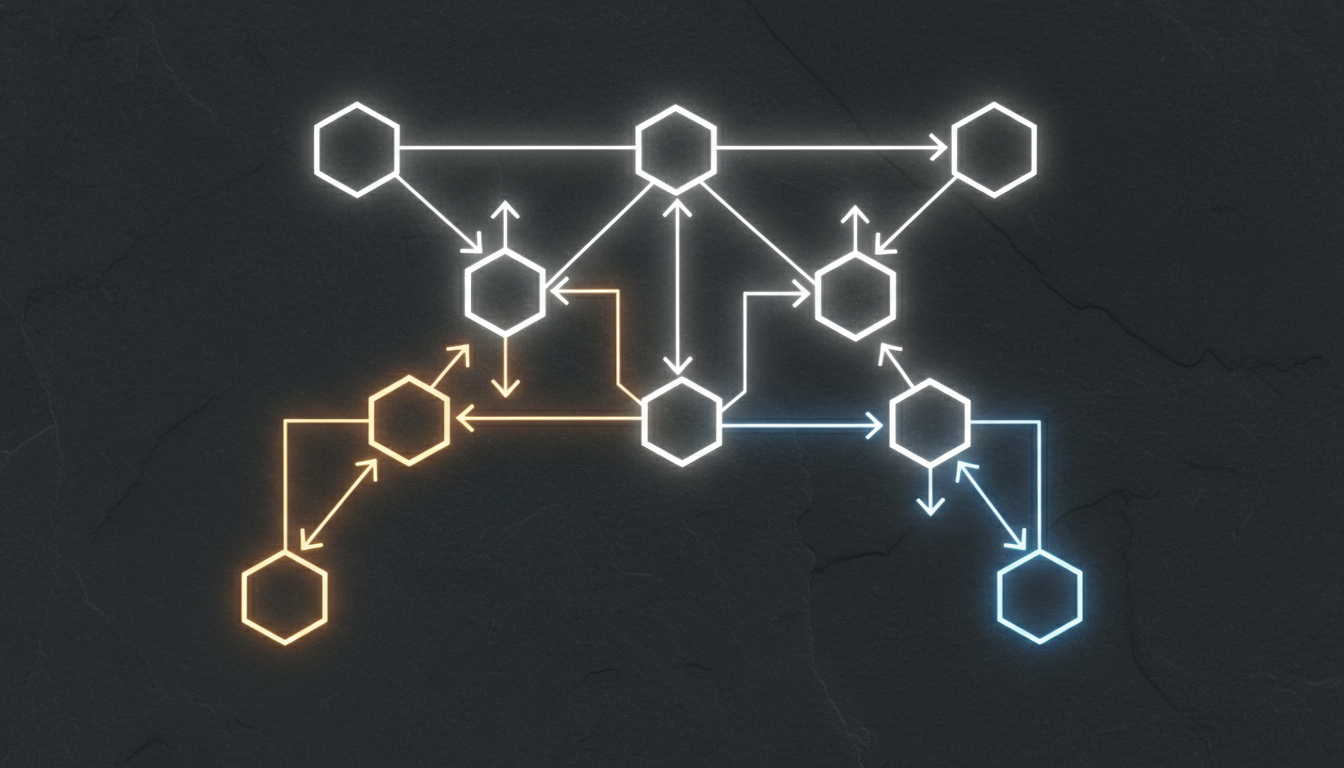
Run through four filters before picking a tool.
Filter 1: Time to first working loop. If you need to show a result inside two weeks, no-code wins on almost every starting position. The visual canvas removes environment setup, dependency management, and boilerplate. You are testing prompt logic on day one instead of day four.
Filter 2: Integration complexity. Count the external systems your agent must touch. If they have REST APIs and the no-code platform already has a connector for them, no-code handles it cleanly. If you need a WebSocket connection, a binary file parser, or a proprietary SDK that has no community node, you are building a custom connector either way. At that point the marginal cost of going fully coded shrinks.
Filter 3: Logic branching depth. Map the decision tree your agent needs to navigate. Fewer than four or five distinct conditional branches with predictable inputs is well inside no-code territory. Deep nested conditionals that depend on parsed model output start to become unmaintainable in a canvas and cleaner in version-controlled code.
Filter 4: Team maintenance profile. Who owns this agent after launch? If the answer is a non-technical operator checking a dashboard, no-code keeps ownership accessible. If the answer is a developer who will extend the agent monthly, code gives them the tools they already know.
The best first agent is the one that runs in production, not the one built on the most impressive stack.
What are the real trade-offs in plain ledger form?
| Factor | No-Code | Coded | |---|---|---| | Time to first working agent | Days | One to three weeks | | Custom integration support | Limited to available nodes | Full, any SDK or protocol | | Logic flexibility | Good up to moderate branching | Unlimited | | Version control | Platform-dependent, often weak | Git-native | | Maintenance ownership | Non-technical friendly | Developer required | | Debugging visibility | Node-level logs | Full stack traces, custom logging | | Vendor lock-in risk | High | Low to moderate | | Upfront skill requirement | Low | Moderate to high |
Vendor lock-in deserves a separate note. When your agent logic lives inside a proprietary canvas, migrating it means rebuilding rather than porting. For a proof-of-concept that might get retired in 90 days that risk is acceptable. For infrastructure you plan to run at volume for two or more years, the lock-in cost becomes material.
Source: Gartner, Hype Cycle for Low-Code and No-Code Technologies, 2023
Does starting no-code trap you later?
Not necessarily, but it can. The risk is not technical, it is architectural. Operators who start no-code and never document their agent's logic in a tool-agnostic way find themselves unable to describe what the agent actually does when they try to rebuild it. The mitigation is simple: write the agent's decision logic as a plain-language spec in a document that lives outside the platform. If you can hand that spec to a developer and they can rebuild the agent from scratch, you are not trapped.
Note
Some operators deliberately use no-code to prototype and coded infrastructure to productionize. That is a legitimate pattern. The no-code version becomes a fast-moving specification environment. Once the logic is validated, a developer ports it to a maintainable codebase. The overhead is real but it is cheaper than building a coded agent on unvalidated assumptions.
For a practical look at how agents stack at the operator level, the 10-agent build overview walks through a layered deployment that mixes both approaches. The agent workflow blog archive has field notes on specific integration patterns that ran into the ceiling issues described above.
The LangChain documentation maintains a current comparison of agent frameworks and their capability envelopes that is worth reading before committing to a coded path.
What is the honest first-agent recommendation?
Build the first agent in whatever environment lets you get to a real user interaction fastest. Real usage surfaces the prompt failures, the edge cases, and the integration gaps that no amount of planning catches in advance. A no-code agent that runs in production next week teaches you more than a perfectly architected coded agent that ships in six weeks.
Once the agent is running and you have observed at least a few hundred real interactions, you will know exactly which constraints you have hit and whether they justify a migration to code. That decision will be grounded in evidence instead of preference.

Operators who want a structured starting point can review the 10-agent framework for a sequenced approach to building out an agent stack without over-committing to infrastructure before you know what the agents need to do.
Michael Rodriguez
Michael Rodriguez has spent 20 years on a dealership floor. With no tech background, he built and runs 22 production AI agents across four businesses on less than $50 a month, in evenings and lunch breaks. Agent Empire is where he ships it in public.
Building agents around a day job? Agent Empire is where operators ship it in public, together. Come build with us.