
September 14, 2026 · Michael Rodriguez
What Does a Minimal Operator Agent Stack Look Like?
A field-tested breakdown of the smallest agent stack that still does real work: roles, tools, and wiring a solo operator can run today.
The short answer
Definition
Operator Agent Stack: An operator agent stack is the full set of AI agents, tools, memory systems, and routing logic a single person or small team runs to complete recurring business workflows without per-task manual input.
Most builder conversations about multi-agent systems jump straight to complexity: vector databases, fine-tuned models, custom APIs, observability pipelines. That is a real build, but it is not the starting line. The starting line is a stack you can wire in a weekend, run for thirty days, and actually understand when something breaks.
What are the non-negotiable layers in any working agent stack?
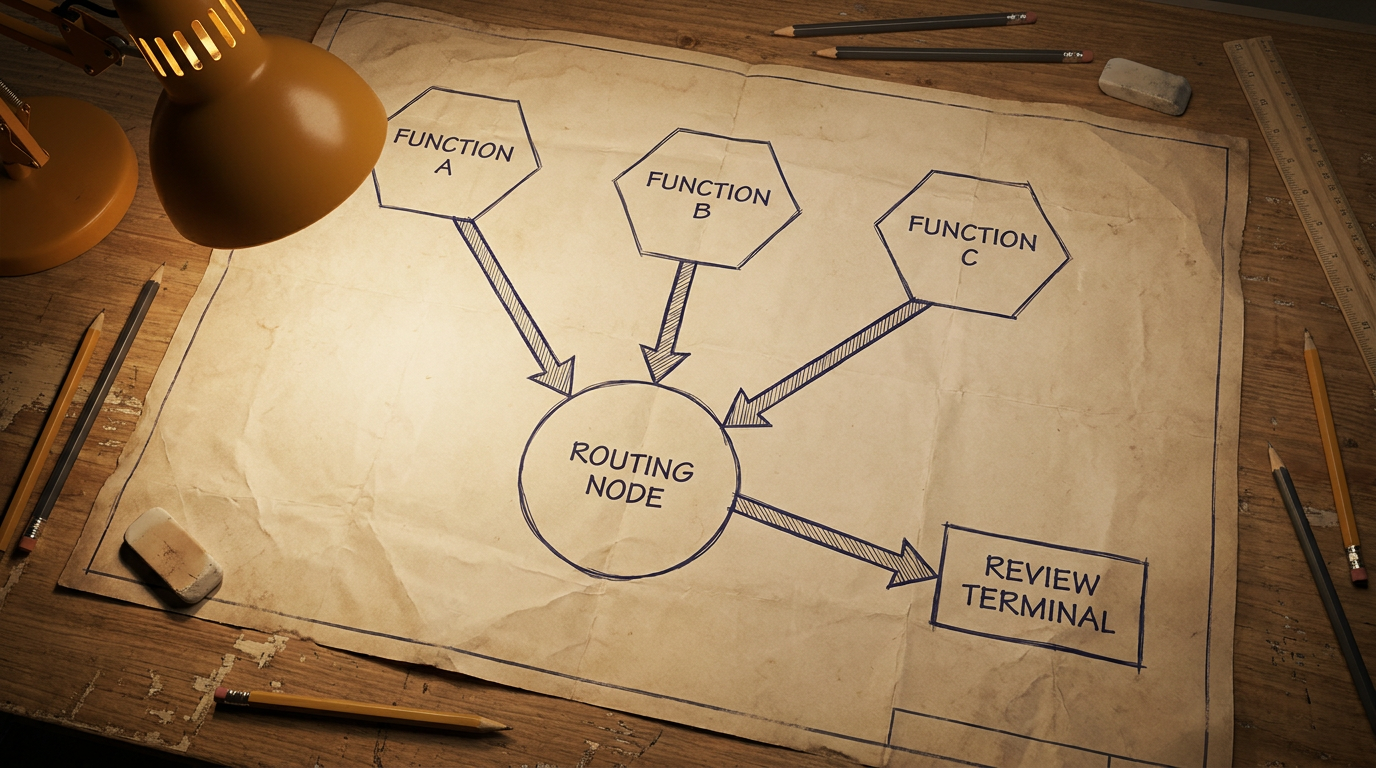
Every functional stack, no matter how small, has the same four structural pieces. Without any one of them the stack either stalls, loops, or produces work you cannot trust.
- Orchestrator - the router that decides which agent runs, in what order, with what inputs. This can be as simple as a GPT-4o system prompt with an if-then chain, or a tool like LangGraph, CrewAI, or a custom n8n workflow.
- Task agents - single-responsibility workers. One agent searches. One writes. One formats and delivers. Giving one agent two jobs is where most early stacks break.
- Memory layer - at minimum a shared context window or a simple key-value store so agents do not re-ask questions already answered. Pinecone, Supabase with pgvector, or even a Google Sheet used as a lookup table all count here.
- Human checkpoint - one defined moment where a person reviews, approves, or redirects before outputs ship. Skipping this is where reputational risk accumulates fast.
Note
How small can the stack actually be?
Three agents is a working floor for most content or research workflows. Here is the ledger for a minimal research-to-draft pipeline:
| Layer | Role | Tooling example | |---|---|---| | Orchestrator | Routes task, manages state | CrewAI manager, LangGraph, n8n | | Research agent | Pulls sources, summarizes findings | Perplexity API, Tavily, Exa | | Writer agent | Drafts output from research brief | GPT-4o, Claude 3.5 Sonnet | | Memory | Shared context between agents | In-memory dict, Supabase | | Delivery | Posts or queues output for review | Notion, Airtable, webhook |
Five rows. That is the whole stack. You are not missing a layer because you are not running it yet. Add layers when a specific failure point demands them, not before.
Which model should run each role?
Model choice is a cost and latency decision, not a prestige one. Use the cheapest model that reliably completes the job at the quality level the task demands.
- Orchestrator: GPT-4o mini or Claude Haiku work well here because routing logic is low-creativity, high-reliability work. You do not need a frontier model deciding which agent runs next.
- Research agent: Models with native tool-use and web search grounding reduce hallucination risk on factual tasks. Perplexity as a standalone API sidesteps the model choice entirely for search.
- Writer agent: This is where a stronger model pays for itself. Claude 3.5 Sonnet or GPT-4o produce noticeably tighter prose than smaller models on open-ended generation tasks.
Use the cheapest model that reliably completes the job. Frontier models at every layer is a cost leak, not a quality strategy.

What does the memory layer actually need to store?
For a minimal stack, memory has three jobs and only three: prevent redundant tool calls, carry user preferences across sessions, and log outputs for human review. A production vector database is not required for any of those jobs at small scale.
A working minimal memory setup:
- A running task log in Airtable or Notion that each agent can read and write
- A preferences file or system prompt section that the orchestrator injects at the start of every run
- An output archive where every agent response is stored with a timestamp before anything is published
When your stack processes enough volume that lookup latency becomes a real bottleneck, that is the moment to introduce pgvector or Pinecone. Not before.
That number explains why the human checkpoint is structural, not optional. Debugging a stack that shipped without one is significantly harder than building the review gate from the start.
How do you wire the agents together without a full engineering build?
The no-code and low-code layer for agent orchestration matured significantly in 2024. For operators who are not writing Python daily, three options cover most use cases:
- n8n: Visual workflow builder with native LLM nodes. Good for connecting agents to real business tools like CRMs, Slack, and email without custom code.
- CrewAI: Python-based but readable. The manager agent pattern maps directly to the orchestrator role described above and requires less boilerplate than LangGraph for simple linear pipelines.
- OpenAI Assistants API with handoffs: The simplest entry point if you are already in the OpenAI ecosystem. Handoffs between assistants are now a first-class feature and require minimal setup.
Note
What should you add to the stack second?
After the three-agent core is stable, the next additions that consistently add value for operator-scale work are:
- A dedicated QA or fact-check agent that runs after the writer and flags unsourced claims before the human checkpoint. This reduces review time and catches the category of error that damages trust fastest.
- A structured output enforcer that validates agent responses against a schema before they move downstream. Prevents malformed data from breaking delivery steps.
- A cost-tracking log that records tokens used and estimated cost per run. Even a simple spreadsheet here turns vague infrastructure spend into a legible ledger.
For a deeper look at how these agent roles map to a full ten-agent build, see the Agent Empire 10-agent framework overview. For specific workflow patterns across content, research, and client delivery, the Agent Empire blog archive has annotated build logs from live stacks.
External resources worth reading before you build: the LangChain State of AI Agents report gives honest failure-mode data, and the OpenAI Assistants documentation is the cleanest reference for understanding handoff mechanics without the framework overhead.
Michael Rodriguez
Michael Rodriguez has spent 20 years on a dealership floor. With no tech background, he built and runs 22 production AI agents across four businesses on less than $50 a month, in evenings and lunch breaks. Agent Empire is where he ships it in public.
Building agents around a day job? Agent Empire is where operators ship it in public, together. Come build with us.